A Hall With a Low Ceiling or a Long, Narrow Room?
Compare a low-ceiling hall and a long, narrow room to spot how sightlines, sound and seating shape the audience’s sense of closeness.
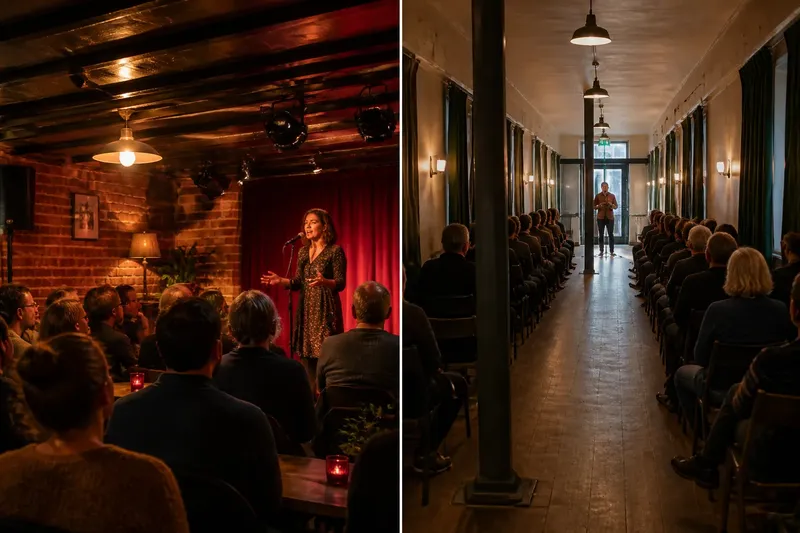
A low-ceiling hall can make a quiet scene feel as though it is happening just across the table; a long, narrow room may draw every gaze towards a distant doorway. When comparing venues, room shape offers useful clues about sightlines and audience closeness before anyone takes a seat. Neither form is automatically better. Each gives a performance a different kind of attention.
What does a low ceiling change?
In a compact hall, the ceiling sits visibly within the room’s social scale. Audience members can feel gathered together rather than spread across a large volume, and a performer’s voice or movement may seem near even from the back. That sense of enclosure can suit spoken scenes, acoustic music or a community performance where faces and small gestures matter.
Look at what hangs overhead. Beamwork, low lights, fans or decorative fittings can affect the view of a raised hand or a performer standing on a platform. A ceiling that feels cosy from the doorway may become visually busy from the seats, especially if the lighting equipment is suspended low.
Notice the room’s width as well as its height. A broad, shallow seating area can let people see one another, but seats near the sides may look across the action at an angle. A narrow stage or playing area can help keep the focus compact; a wide one may leave the edges feeling far away despite the low ceiling.
Check for heads and overhead fittings from more than one seat.
How does a long, narrow room guide attention?
A long room tends to establish a strong front and back. Its shape can make a procession, a line of performers or a scene centred on a far entrance easy to follow. Yet distance matters: a small facial expression may be clear near the front and harder to read towards the rear.
Look for where the audience sits in relation to the performance area. If the room has seating along both long sides, the action may feel surrounded, but people may see profiles rather than faces for parts of the show. If all seats face one end, the room can create a clear shared focus, while the back row may feel removed from the performers.
Doors and aisles also become prominent in a narrow layout. A side entrance can offer a natural route for performers, while a central aisle may divide the audience’s view. Listen for ordinary sounds such as a door closing or people moving at the back: in a long room, those sounds may seem to come from a distinct point behind the performance.
Try tracing the performer’s likely route from entrance to playing area with your eyes.
Where might the view feel blocked?
“Good sightlines” are not just a matter of seeing the stage. A child, a seated adult and someone standing at the back may have different views from the same part of the room. A pillar, a speaker, a railing or a tall seat in front can interrupt one person’s view while leaving another’s open.
Ask whether the playing area is raised, and whether the venue has a seating plan or access information. If you can visit, check the view from a side seat and from the rear, not only from the centre aisle. At a smaller local venue, the person welcoming you may know which seats have an unusual angle or where a support column falls.
Imagine a local spoken-word evening in a long room, with the microphone at one end and a pillar near the middle. If you arrive early, you could look from a seat behind the pillar and then from a side seat; the observable difference is whether the speaker’s face remains visible when they move. That check helps you choose a place suited to the performance rather than relying on the room’s shape alone.
Which room details should you listen for?
Room shape can influence how sound seems to travel, but surfaces and furnishings matter too. A bare hall may make a voice linger or blur, while curtains, carpets and upholstered seats can soften the impression of sound. A narrow room may seem direct when performers speak towards one end; a low room may feel intimate without making every word equally clear.
Before a show, listen to a short announcement from the front or ask whether the venue can provide sound access information. If music is part of the event, consider whether the room’s shape gives performers space to spread out or places them close to the audience. These are clues, not predictions: the way a show is arranged can change the experience substantially.
For a performance where quiet speech matters, ask about amplification or seating options rather than assuming closeness will make every line easy to hear.
What do audiences often ask about room shape?
Does a low ceiling always make a venue feel intimate?
It can help a room feel gathered, but intimacy also depends on seating distance, lighting and how performers use the space. A low ceiling with a wide, spread-out layout may feel less close than a room where the audience sits near the action.
Are seats at the back of a narrow room always poor?
Not necessarily: a clear central view can work well for movement and overall stage pictures. For subtle facial expression, check whether the performance area is raised and whether the venue offers a view description or seating advice.
Which shape is better for a community performance?
That depends on what the event asks the audience to notice. A close, conversational piece may benefit from a compact feeling, while a procession or line of performers may use a long room’s depth more effectively.
Can I judge sightlines from a venue photograph?
A photograph can show the general layout, ceiling and visible obstructions, but its camera position may hide the view from particular seats. Treat it as a starting point and ask about seating or access details if your view needs are specific.
How can you compare venues before choosing?
Start with the event, not a verdict about the building. For a storytelling night, you might favour a room where faces are visible and speech feels close; for a staged entrance or a moving ensemble, depth may be useful. If the programme combines both, look for a layout that gives the performers clear routes while keeping the audience’s view open.
- Check whether seats face one end, surround the playing area or sit along its sides.
- Look for pillars, rails, low fittings and speakers that could interrupt a view.
- Ask whether the rear seats have a clear sightline to the performers’ faces.
- Notice how doors and aisles might affect entrances, movement and quiet moments.
- Consider whether the event depends more on small gestures, broad movement or spoken detail.
- Ask the venue about access and seating arrangements that matter to your visit.
Those observations make a comparison more useful than labels such as “cosy” or “grand”. A low-ceiling hall may draw an audience into a shared, close focus; a long, narrow room may give a performance direction and depth. When choosing a venue, the most helpful question is what the room lets you see, hear and feel connected to during this particular event.